
Home › Coverages › Snow Plow Insurance for Landscapers
Snow plow and snow removal insurance
Snow plow insurance for a landscaping company is usually two policies working together: commercial auto for the plow truck and general liability for slip-and-fall claims after you leave the lot. Many landscaping policies exclude or limit snow work, so whether you can be covered depends on how much plowing you do, whose lots you clear and how your contracts read.
- Since 2003
- 12+ A-rated carriers
- 28 states
- Independent agents
Start your landscaping insurance quote
Takes about a minute. A licensed agent follows up.
Licensed in 28 states · NPN 7642818 · Since 2003
How snow plow insurance works for a landscaper
For most landscapers, snow plow insurance isn't one policy. It's the right wording on the policies you already carry, plus an honest conversation about how much winter work you do. The pieces split along the line between your truck and your finished work.
A pickup or dump truck with a plow mounted on it is an "auto" under the standard ISO forms, not a piece of mobile equipment. So the truck and what the blade hits while you're plowing usually fall to your commercial auto policy. Injuries after you've driven away, like a tenant who slips on a walk at noon, are a general liability question. A plow or pusher on a skid steer, tractor or UTV that isn't road-registered is usually mobile equipment, which also puts its plowing on the general liability side.
Carriers also rate snow work on its own. The ISO general liability class for it is 99310, Snow and Ice Removal—Contractor, separate from landscape gardening and lawn care. If your policy is classified only for mowing and planting, plowing may not be what the carrier agreed to insure.
| What usually responds | Where the gaps usually are |
|---|---|
| Commercial auto, when the blade hits a car, curb or pole while you're plowing | A slip-and-fall after you leave, if the liability policy lacks snow-plow completed operations wording |
| Auto physical damage for the plow truck, if it's insured for that | The plow's own value, if it was never added to the truck's coverage |
| General liability for a skid steer or UTV pusher that damages property on site, if the policy allows snow work | Any snow claim on a policy that excludes snow and ice removal |
| Additional insured status for the property owner, by endorsement, when the contract calls for it | Promises in a contract that go beyond what the policy treats as an "insured contract" |
| Equipment coverage for the skid steer, pusher box and spreaders | Injuries to your own plow drivers, which belong on workers' comp |
Three winter claims and where each one lands
These are made-up examples, not claim data. Real outcomes depend on your policy wording, your contract and your state's law.
Example scenario: a hidden island at 3 a.m.
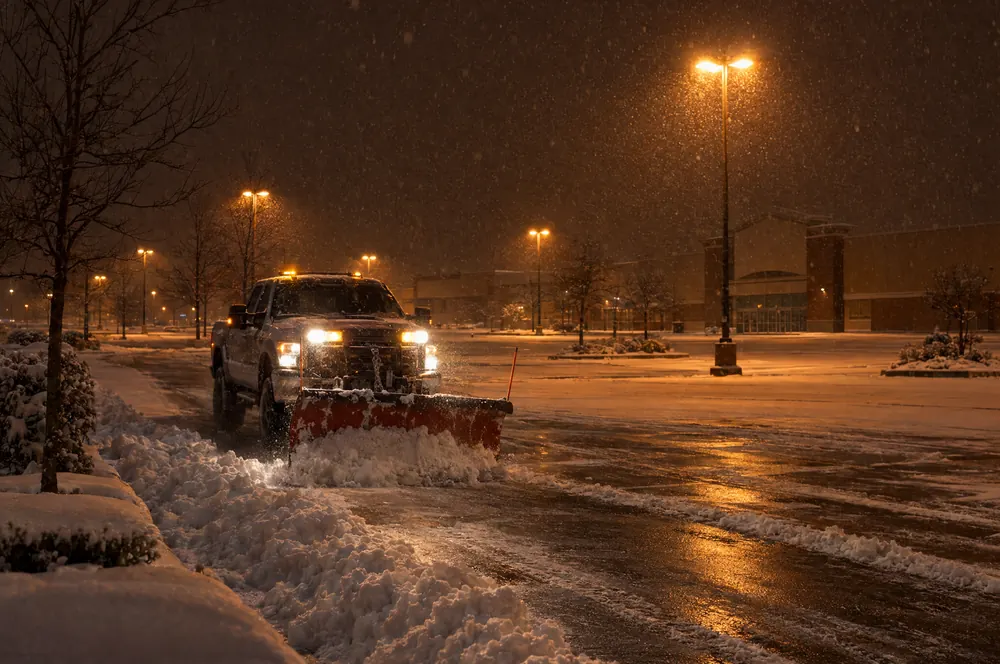
A driver plowing a dental office lot in heavy snow catches a buried curb island and shoves the blade into a light pole base. The pole cracks. The damage happened while the truck was in use, so it is usually a commercial auto liability claim, subject to the policy's terms.
Example scenario: the clinic walk, six hours later
Your crew clears and salts a medical clinic's entrance before dawn. Near lunch, a patient falls on a slick patch by the door and breaks a wrist. The auto policy excludes completed operations. The liability policy's auto exclusion may reach the claim too, because the work traces back to a plow truck. Wording built for snow-plow completed operations is what closes that gap.
Example scenario: a pusher box at the townhomes
A lawn care owner clears an HOA's townhome drives with a skid steer and a pusher box. He backs into a brick mailbox column. A skid steer is usually mobile equipment, so this is a general liability claim, but only if that policy doesn't exclude snow work.
Why many landscaping policies exclude or limit snow work
What snow underwriters ask, and what moves the price
Expect detailed questions. Underwriters who will consider snow work often want to know:
- Snow's share of your revenue. A few residential driveways on top of a full mowing book is a different risk from a winter-first company.
- Whose property you clear. Homeowners, HOAs, apartment complexes, retail lots and public roads all rate differently, and big retail accounts draw the most scrutiny.
- Your contracts. Whether you work under written agreements, and whether the hold-harmless clause runs in your favor or the owner's.
- Your records. Dated logs of when you plowed and salted, and what you applied.
- Contract terms on timing and scope. Who decides when you plow and salt, and whether ice control is in your scope at all.
- Your vehicles and subs. Whether every plow truck is on a commercial auto policy, whether that policy excludes plowing, and whether your subcontracted plowers send certificates.
None of these answers guarantees a lower premium or a win in court. They show an underwriter the risk is managed. Our snow removal contracts guide walks through the contract terms in detail.
Your price depends on your payroll and class codes, your revenue, the services you offer (especially chemical work), your trucks and trailers, your claims history and the limits you choose. For snow, add the share of revenue it brings in and the type of lots you clear. We don't publish snow pricing because it swings so widely by account.
How a landscaper who plows on the side may be covered
This page is for the mowing and maintenance company that keeps a few trucks and crew members working in winter. If that's you, set things up before the first storm, not after the first claim.
- Tell us about every snow account in the fall. Include the revenue it brings, the property types and a copy of each contract.
- Get snow work onto the liability policy on purpose. Ask that it be classified and not excluded, and ask whether snow-plow completed operations wording is attached.
- List every plow truck on your commercial auto policy. Confirm the plow's value is included in the truck's physical damage coverage.
- Schedule pushers and skid steers on your equipment coverage.
- Match the contract's limits. Commercial snow contracts often ask for more than your base policy carries, which an umbrella can supply.
- Line up certificates early. Property managers want proof before the season starts. Our certificate of insurance guide explains additional insured wording.
Year-round accounts are where this comes up most. Commercial grounds maintenance crews get asked to plow the same HOAs and office parks they mow, and lawn care companies often pick up driveways from their summer customers. Get a quote for your landscaping business →
Snow plow rules by state
Most of what matters for snow coverage is set by your policy and your contract, not a state license. State law still shapes two things. First, a few states have passed laws that void one-sided indemnity clauses in snow removal contracts; our contracts guide covers which ones. Second, each state sets its own deadline for injury lawsuits, so a fall from February can turn into a claim long after the thaw.
Most liability policies here are occurrence-based, meaning the policy you had on the date someone fell answers the claim, even if the suit comes later. Keep each season's logs, contracts and policy information, and report incidents right away. Rules and markets differ by state, so check your state page for local requirements.
Related coverage
Frequently asked questions
Does landscaping insurance cover snow plowing?
How much does snow plow insurance cost?
Does my commercial auto policy cover my plow truck?
Who pays if someone slips after I plow a parking lot?
Is a plow on a skid steer covered differently than a plow truck?
Ready to see what you'd pay?
Independent agents, 12+ A-rated carriers, and a licensed agent back to you within one business day.