
Home › Coverages › Landscaping Equipment Insurance
Equipment and tools insurance for landscapers
Landscaping equipment insurance pays to repair or replace mowers, skid steers, aerators, sprayers and other gear that's stolen or damaged at the shop, on the trailer or at a client's property. It's usually written as a contractor's equipment floater, an inland marine policy that follows your machines from stop to stop.
- Since 2003
- 12+ A-rated carriers
- 28 states
- Independent agents
Start your landscaping insurance quote
Takes about a minute. A licensed agent follows up.
Licensed in 28 states · NPN 7642818 · Since 2003
What landscaping equipment insurance covers
Landscaping equipment insurance covers the machines and tools your crews depend on, wherever they happen to be. The usual form is a contractor's equipment floater. It's called inland marine because it insures property that moves, and a mower that rides from the yard to the trailer to a dozen lawns a day fits that description.
Your other policies leave this gear out. General liability pays for damage you do to other people's property, not to your own. Commercial auto covers the truck and anything bolted to it, not the loose mowers and blowers on the trailer.
A floater usually sorts your gear into two groups:
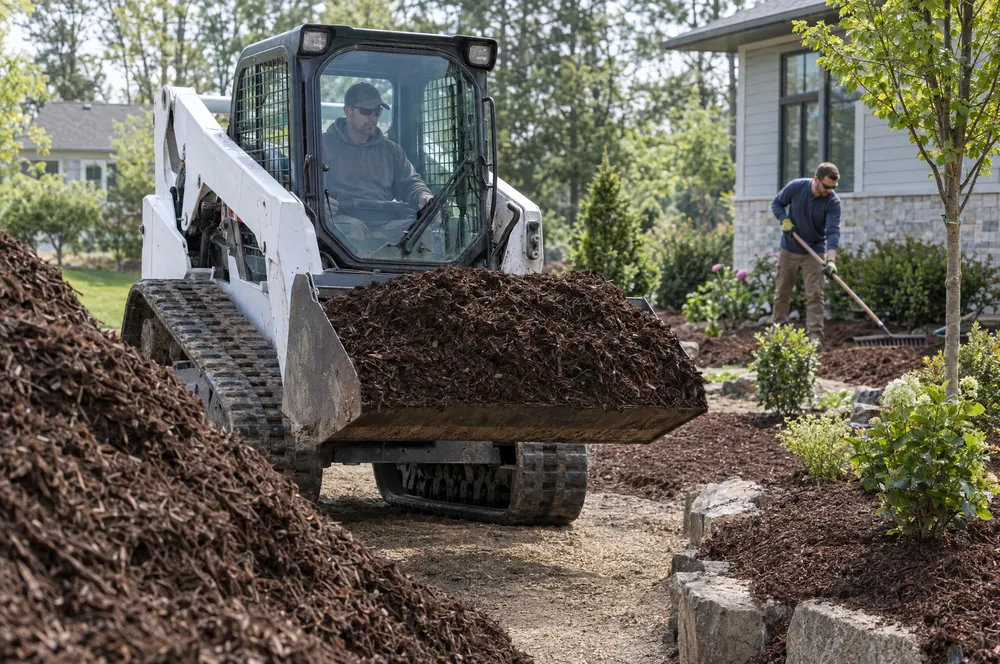
- Scheduled items. Big-ticket machines are listed one by one with a value: zero-turns, stand-on mowers, skid steers, compact track loaders, mini-excavators, aerators, hydroseeders, and the enclosed or dump trailer itself if it isn't insured on the auto policy.
- Blanket or unscheduled items. Trimmers, edgers, backpack blowers, backpack sprayers and hand tools share one total limit, usually with a per-item cap. Make sure that cap is higher than the most expensive item you didn't schedule.
Rented and leased machines can be covered too. A standard contractors' equipment form can include equipment of others in your care, custody or control when it's described on the declarations or on a schedule you file with the insurer. Rental and lease agreements often require you to insure the machine and name the owner as loss payee. Rental reimbursement can help pay for a stand-in machine while yours is in the shop. Get a quote for your landscaping business →
| What it covers | What it usually doesn't |
|---|---|
| Scheduled mowers, loaders and trailers stolen from the yard or a job | Gear that simply goes missing with no sign of theft (mysterious disappearance) |
| Fire, collision or overturn damage to your machines | Normal wear, a worn-out deck or a blown engine from age |
| Small tools and blowers under a blanket limit | Any single item above the blanket's per-item cap |
| Rented or leased equipment described on your schedule | Rented machines you never told the insurer about |
| Equipment in transit, parked at the shop or at a property | Injuries or damage to others caused by the machine (that's general liability) |
| Materials headed for an install, if you add an installation floater | Plants that die from drought, disease or poor care |
How equipment claims play out
The whole rig gone overnight
Example scenario: A two-truck lawn care company leaves its enclosed trailer hitched in the owner's driveway on a Sunday night. By Monday at 6 a.m., the truck is still there but the trailer is gone, along with two stand-on mowers, a walk-behind, four trimmers and a blower. The trailer itself may be an auto claim if it's listed for physical damage. The equipment inside is a floater claim. That's two policies and often two deductibles, and the floater may first ask whether the trailer was locked.
The rented track loader on the slope
Example scenario: An install crew rents a compact track loader for a retaining wall job on a hillside lot. The operator turns across the grade, the machine rolls onto its side, and the cab and hydraulics are damaged. If the loader was added to the floater as rented equipment, the policy can respond to the rental company's repair bill. If not, the company could owe the repair out of pocket. Compare your floater with the rental counter's damage waiver before paying for both.
The mower that was never scheduled
Example scenario: A maintenance company buys a new 61-inch zero-turn in April and assumes the blanket limit covers it. A fire in the storage shed destroys the mower in August. The blanket has a per-item cap well below the mower's price, so the payout falls short. Scheduling the machine the week it arrived would have avoided the gap.
Materials for an install job
Limits and what equipment coverage costs
Your limits should match what it would cost to replace each machine today, plus a blanket amount that covers the small gear on a fully loaded truck. Deductibles often apply per occurrence, so one trailer theft usually means one floater deductible.
| Source | Figure | What it measures |
|---|---|---|
| One large online insurance marketplace | About $53 a month ($637 a year) | Median tools and equipment premium for its landscaping customers, updated 2026-10-12 |
That median reflects small operations. A company scheduling several skid steers and loaders usually pays more. Your price depends on your payroll and class codes, your revenue, the services you offer (especially chemical work), your trucks and trailers, your claims history and the limits you choose. The cost guide shows equipment next to the other policies.
Who needs equipment coverage most
- Mowing routes. For a small lawn care business, the mowers and trailer are often the most valuable things it owns. A financed stand-on usually comes with a lender's insurance requirement anyway.
- Install and hardscape crews. Owned and rented loaders, plate compactors and saws carry high values and travel constantly. See landscape contractor insurance.
- Commercial grounds companies. Multiple crews mean multiple trailers parked at multiple sites. A blanket that made sense with one crew may be far too small with five. Commercial landscape maintenance insurance covers the contract side. Get a quote for your landscaping business →
Equipment rules that differ by state
No state we've researched requires equipment insurance, but local rules are changing what sits on your trailer, and battery fleets cost more to replace.
- California requires most newly made small off-road engines, including mowers, blowers and string trimmers, to be zero-emission starting with model year 2024. Generators and large pressure washers follow a later schedule. Battery packs and chargers push up the value of each trailer.
- Connecticut towns are limiting gas blowers. Stamford's Ordinance No. 1322, passed in November 2025, will allow them only from October through December once its three-year transition ends, and it applies to landscaping companies as well as residents.
- Virginia has Alexandria's ordinance regulating gas-powered leaf blowers, which takes effect November 17, 2026, after an 18-month phase-out.
- New York villages like Southampton have banned gas-powered leaf blowers since October 1, 2024.
When you switch to battery gear, update your schedule. Find every licensed state on our state list.
Related coverage
Frequently asked questions
Is my lawn mower covered if it's stolen off my trailer?
Does general liability cover my landscaping equipment?
Do I need insurance on a rented skid steer?
What's the difference between scheduled and blanket equipment coverage?
How much is lawn equipment insurance?
Ready to see what you'd pay?
Independent agents, 12+ A-rated carriers, and a licensed agent back to you within one business day.