
Home › Coverages › Commercial Landscape Maintenance Insurance
Insurance for commercial grounds maintenance companies
Commercial landscaping insurance is the coverage, endorsements and limits that HOAs, property managers and cities write into a grounds maintenance contract before your crews can start. We line up the general liability, umbrella, auto and comp those exhibits demand, then check the wording against the contract so your certificate matches what the client actually asked for.
- Since 2003
- 12+ A-rated carriers
- 28 states
- Independent agents
Start your landscaping insurance quote
Takes about a minute. A licensed agent follows up.
Licensed in 28 states · NPN 7642818 · Since 2003
Commercial landscaping insurance starts with the people walking past your crews
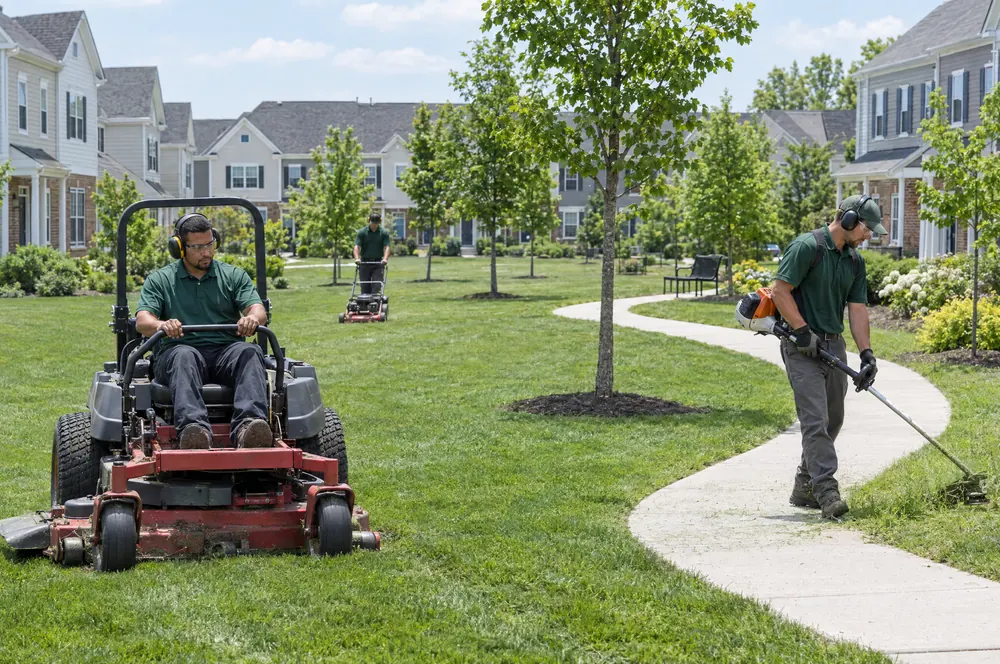
On a commercial site, most of the people near your equipment aren't your customer. Tenants, shoppers, students, residents and delivery drivers walk through while you mow, blow and edge. When one of them gets hurt or their car gets damaged, the claim often names the owner, the management company and you, and the contract usually says your policy goes first.
That's why commercial landscaping insurance looks different from a residential route's coverage. The policies are mostly the same: general liability, auto, comp and equipment. What changes is the paperwork around them, the higher limits, and the number of sites sharing one policy.
A few exposures show up mostly on commercial work:
- Parking lots and loading areas. Blowers and mowers run a few feet from parked cars and moving traffic, every week, at dozens of properties.
- Medians and rights-of-way. City and county contracts put crews and trailers beside live lanes, which raises both auto and crew injury risk.
- Retention ponds and steep banks. Stand-on and zero-turn mowers working near water and slopes are a common source of serious crew injuries.
- Common-area chemical work. Weed control around playgrounds, pools and walkways invites exposure complaints, and some public owners limit spraying near play areas in their own policies.
Example scenario: A maintenance crew is clearing clippings from an office park's front drive with a backpack blower. A visitor stepping out of a rideshare is hit in the eye by grit. She files a claim against the building owner, the management company and the landscaper. The maintenance contract makes the landscaper's liability policy respond first, so the endorsements on that policy decide whether the owner gets a defense from your carrier.
The coverage commercial grounds contracts usually require
Most commercial exhibits ask for the same core lines. Here's how they stack for a maintenance company.
General liability with contract endorsements
The base policy, with additional insured, primary and non-contributory, and waiver wording to match the exhibit. General liability for landscapers
Umbrella
The usual way to reach the higher limits a contract names, sitting over your liability, auto and employer's liability. Umbrella for grounds contracts
Commercial auto
Owned, hired and non-owned vehicles, since many exhibits name all three, plus trailers in a growing fleet. Commercial auto for crew fleets
Workers' comp and employer's liability
Comp for every crew, including seasonal workers, with employer's liability limits the contract names. Workers' comp for grounds crews
Chemical application
For common-area fertilizer and weed control, where a standard policy may limit pollution-type claims. Pesticide and herbicide coverage
Performance bonds
Public grounds contracts and some large private ones ask for a bond that guarantees you'll finish the term. Performance and maintenance bonds
Where commercial maintenance accounts trip up
What a commercial landscaping contract will ask you for
Beyond limits and endorsements, commercial landscaping contract exhibits increasingly reach into how you run crews. Before you sign, look for:
- Notice terms. Many exhibits ask for advance notice of cancellation. Your certificate can't promise more than your policy provides.
- License copies. Anyone applying fertilizer or weed control on the property usually needs the state applicator license, and the client may want it on file.
- Heat safety plans. In Arizona, Phoenix requires contractors with outdoor workers on city contracts to keep a written heat safety plan, posted in English and Spanish.
- Equipment rules. In Illinois, Northbrook formally warned its own landscape contractor that one more gas-blower violation would end the contract.
- Water limits. In Nevada, Las Vegas valley water-waste fees run from $40 up to $5,000 for repeat violations, and crews who program a client's controllers can trigger them.
If a property manager also wants winter plowing on the same lots, that's quoted separately and underwritten carefully, so raise it before you price the maintenance bid.
Adding accounts, crews and bigger contracts
Commercial maintenance companies usually hit the same milestones in the same order. Each one is a good moment to call us.
- The first HOA or property manager. Endorsements and a certificate become routine. Ask for blanket additional insured wording so every new signed account doesn't need a separate change.
- A portfolio of sites. Ask about a per-location aggregate so one bad property can't use up the limit for the rest.
- The first public bid. Expect higher limits, a rating minimum for your insurers and, often, a performance bond. Sureties look at your financials and track record, so start that conversation before bid day.
- An H-2B crew. Visa workers go on your comp policy like anyone else. If you drive them in company vans, federal H-2B rules require that transport to meet motor-carrier insurance standards at a minimum.
- An office that handles the money. HOAs and managers pay large invoices by transfer. A spoofed email that reroutes a payment is a cyber or crime question, not a liability one.
Growth in this segment also tends to add enhancement work: seasonal color, mulch installs, small plantings. That's often rated under an installation code for comp, not lawn maintenance. Keep those hours separate on your payroll so each crew lands in the right class.
Frequently asked questions
What insurance do I need for commercial landscaping contracts?
How much liability insurance do HOAs require from landscapers?
How fast can I get a certificate for a new property manager?
Do my subcontracted mowing crews need their own insurance?
Why does a city want my insurers rated A:VII or better?
Related pages
Ready to see what you'd pay?
Independent agents, 12+ A-rated carriers, and a licensed agent back to you within one business day.