
Home › Coverages › Business Owner's Policy for Landscapers
A business owner's policy for landscaping companies
A business owner's policy (BOP) packages general liability with property coverage for your shop, office and stored materials, plus business income if a covered loss shuts you down. Some landscaping companies qualify for one, but carriers screen this trade closely, so it's an option to check rather than a default.
- Since 2003
- 12+ A-rated carriers
- 28 states
- Independent agents
Start your landscaping insurance quote
Takes about a minute. A licensed agent follows up.
Licensed in 28 states · NPN 7642818 · Since 2003
What a business owners policy does for a landscaping company
A business owners policy, usually called a BOP, combines three coverages that small companies need at once: general liability, property insurance for the building and what's in it, and business income. Buying them together is often simpler and can cost less than buying each one separately.
For a landscaping company, the property side is the part that matters most. It can cover:
- the shop or pole barn you own, or your improvements to one you rent
- office computers, the parts room and inventory on the shelves
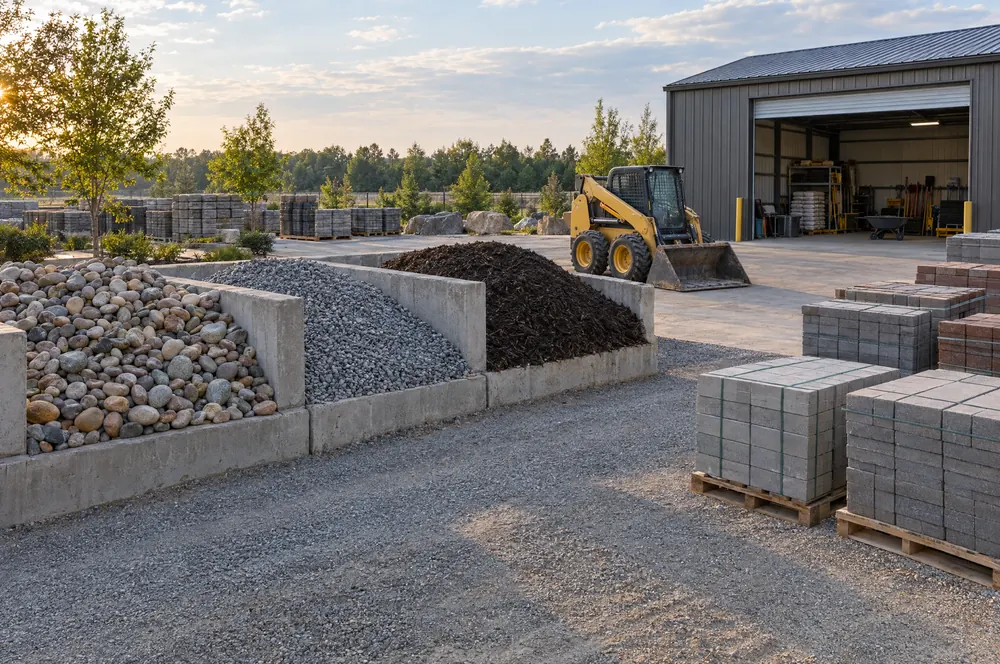
- pallets of stone, bagged and bulk mulch and pavers stored in the open within 100 feet of your building
- lost income and extra expenses while a covered fire or storm keeps you out of the shop
A BOP never replaces your other core policies. It doesn't include workers' comp, it doesn't insure your trucks and it doesn't cover professional design errors. You'll still need commercial auto and, once you hire, workers' comp. Get a quote for your landscaping business →
| What a BOP may cover | What it usually leaves out |
|---|---|
| Liability for injuries and damage your work causes to others | Your crew trucks and trailers (commercial auto) |
| Your shop building, office contents and parts inventory | Injuries to your own employees (workers' comp) |
| Stone, mulch and pavers stored in the open near your building | Trees, shrubs and container stock, beyond a small outdoor extension |
| Lost income after a covered fire or windstorm at the shop | Chemical application claims, unless an applicator endorsement is added |
| Limited clean-up of pollutants on your premises after a covered loss | Contamination that spreads off your property |
| Mowers and tools kept at the shop, depending on the form | Equipment out on jobs, which is usually better on an equipment floater |
Where a BOP helps and where it stops
The shop fire in March
Example scenario: An electrical fire guts a landscaping company's rented shop three weeks before spring cleanups start. The office computers, the parts room and the shelving are lost, and the crews have nowhere to load out for a month. The BOP's property coverage can pay to replace the contents, and business income can help cover payroll and lost profit while a temporary yard is set up, subject to the policy's limits and waiting period.
The windstorm in the holding yard
Example scenario: A design-build firm stages 80 container shrubs and a dozen balled-and-burlapped trees behind its shop for a June install. A summer windstorm tips the containers and snaps several trunks. On the standard BOP form, trees, shrubs and plants are mostly not covered property. The small outdoor property extension responds only to fire, lightning, explosion, riot or civil commotion and aircraft, so wind damage to that stock likely isn't covered. Nursery stock needs its own coverage, such as an inland marine form.
The fuel tank behind the shed
Example scenario: A fire in an equipment shed ruptures the company's above-ground fuel tank, and diesel soaks into the soil next to the building. Because a covered cause of loss started the release, the BOP's pollutant clean-up coverage can help pay to remove it. On the ISO form, that coverage tops out at $10,000 per location per year, and the clean-up bill may run past it. If fuel reaches a neighbor's property, the liability side runs into the pollution exclusion, which is why a storage-tank or premises pollution policy is the usual fix.
Limits and what a BOP costs
You set separate limits for each part. Liability is often $1 million per occurrence. The building limit should match rebuilding cost, and the business personal property limit should cover the contents plus the stone, mulch and pavers you keep on hand at your busiest point in the season, not in January.
| Source | Figure | What it measures |
|---|---|---|
| One large online insurance marketplace | About $92 a month ($1,101 a year) | Median BOP premium for its landscaping customers, updated 2026-10-12 |
Your price depends on your payroll and class codes, your revenue, the services you offer (especially chemical work), your trucks and trailers, your claims history and the limits you choose. For a BOP, the building's construction, its age and its distance from a fire station also matter. More published figures are in the landscaping insurance cost guide.
Crime is its own question. A crew member running personal fuel on a company card, stolen materials or a fake vendor email that reroutes a payment are usually handled by crime or cyber coverage, not by the BOP's property section.
Who a BOP suits best
- Owner-run mowing and maintenance companies with a shop, modest payroll and no tree removal. For many lawn care businesses, a BOP plus auto and an equipment floater covers the basics.
- Grounds maintenance firms with a yard full of materials. Stored stone and mulch are a real property exposure, and a contract client may ask for proof of liability coverage. Commercial landscape maintenance insurance covers the contract side.
- Install firms, with care. Grading and excavation can push a landscape contractor out of BOP eligibility, so separate policies are often the cleaner fit. Get a quote for your landscaping business →
Requirements by state
No state requires a BOP. The landscape, pesticide and irrigation license rules on our state pages ask for liability insurance in some states, and a BOP's liability section can meet that requirement when the limits and wording match. Check the exact requirement for your license before you rely on it. Start from the list of states where we're licensed.
Related coverage
Frequently asked questions
Can a landscaping company get a business owner's policy?
Does a BOP cover my mowers and trailers?
Does a BOP cover the plants and trees in my yard?
Is a BOP cheaper than buying general liability and property separately?
Does a business owner's policy cover lawn chemical application?
Ready to see what you'd pay?
Independent agents, 12+ A-rated carriers, and a licensed agent back to you within one business day.