
Home › Coverages › General Liability Insurance for Landscapers
General liability insurance for landscapers
General liability insurance for landscapers pays when your crew's work injures someone outside your company or damages property you don't own, and it pays for your legal defense when that turns into a lawsuit. It won't redo your own work, and some low-cost policies leave out chemical application, irrigation installs, hardscape or stump grinding, so the exclusions matter as much as the price.
- Since 2003
- 12+ A-rated carriers
- 28 states
- Independent agents
Start your landscaping insurance quote
Takes about a minute. A licensed agent follows up.
Licensed in 28 states · NPN 7642818 · Since 2003
What general liability insurance for landscapers pays for
General liability insurance for landscapers covers bodily injury to people outside your business and damage to property that isn't yours, when your operations or finished work cause it. It also pays to defend you when someone sues over that kind of claim. It's usually the first certificate an HOA, a property manager or a town clerk asks to see.
Contractor GL is typically an occurrence policy. Whichever policy was in force on the day the damage took place handles it, even when the homeowner calls the following spring. A common setup for a small landscaping company is $1 million per occurrence with a $2 million aggregate.
Your class codes decide what's covered
Carriers rate GL by ISO class code. Landscaping usually falls under 97047 (Landscape Gardening), lawn care under 97050 (Lawn Care Services), and tree pruning and trimming under 99777. Some contractor policies add a classification limitation that ties coverage to the operations listed on the declarations. If you mow, install and prune, list all three, or a claim from the unlisted work can be disputed. New owners usually buy this policy first; see where it fits in our guide to starting a landscaping business.
What landscaping liability insurance covers, and what it usually doesn't
| Usually covered | Usually left out |
|---|---|
| Damage your crew causes to a client's or neighbor's property | The cost to redo your own faulty work |
| Injuries to clients, residents, tenants and passersby | Injuries to your own crew (that's workers' comp) |
| Legal defense when you're sued over a covered claim | Your mowers, trailers and tools (equipment coverage) |
| Damage that shows up after the job is done (completed operations) | Your trucks on the road (commercial auto) |
| A client added as additional insured, by endorsement | Chemical drift or overspray, unless the pollution exclusion is bought back |
| Buried utility lines cut while digging, usually | Errors in plans or designs you draw (professional liability) |
Example claims on a landscaping liability policy
These are made-up situations. Whether a real policy pays depends on its wording and your state's law.
Gravel through a clinic door
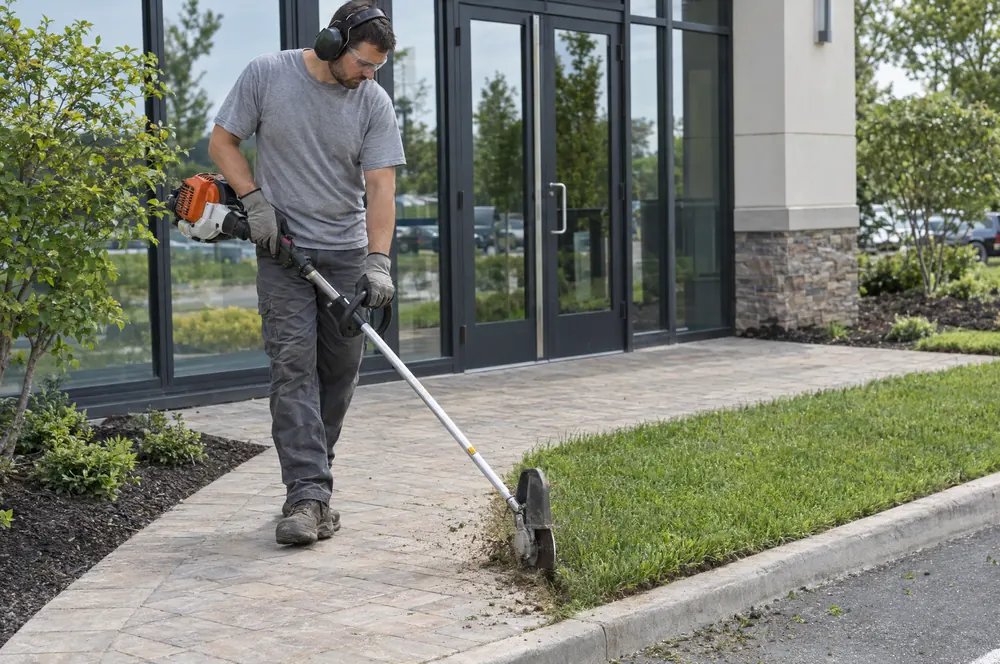
Example scenario: A crew member is running a line trimmer along the curb strip outside a dental office. A piece of pea gravel shatters the glass entry door just as a patient walks out, and the flying glass cuts her forearm. She wants her medical bills and missed workdays paid, and the building owner wants a new door. Both are third-party claims, the kind GL exists for.
A French drain that failed in November
Example scenario: In April your install crew ties a homeowner's downspouts into a new French drain. In November a joint pulls apart, water backs up against the foundation, and the finished basement floods. The ruined flooring, drywall and furniture fall under completed operations, the part of GL for damage that appears after the job is finished. Digging up and rebuilding the drain is usually on you, because GL generally doesn't pay to fix your own work.
A fiber line under the side yard
Example scenario: A trencher cutting a path for a new drip zone snags a fiber-optic cable a few feet from where it was marked. Internet service drops for the whole block, and the provider sends a repair bill. GL usually responds to a utility strike as property damage, though some policies limit underground damage. State one-call laws require notice before you dig, and skipping the 811 call can shift the blame to you.
Exclusions that catch landscapers
Limits and what drives the price
Start from the contracts you hold or want. $1 million per occurrence covers many residential and small commercial accounts. Standard GL forms also carry a separate products-completed operations aggregate, so check that line on your declarations, not just the general aggregate. Cities and large property managers often write in more, and an umbrella policy is the usual way to get there without rebuilding your GL.
| Source | Figure for landscaper GL | Limits |
|---|---|---|
| One large online insurance marketplace (median of its landscaping customers) | About $63 a month ($761 a year) | $1M / $2M |
| MoneyGeek (average for lawn care and landscaping) | About $198 a month ($2,382 a year) | $1M / $2M |
A median and an average measure different things, so treat the gap as a range, not a contradiction. Your price depends on your payroll and class codes, your revenue, the services you offer (especially chemical work), your trucks and trailers, your claims history and the limits you choose. The landscaping insurance cost guide breaks the numbers down further.
Who needs it most
Every landscaping business with customers needs GL, but the pressure points differ by segment. A mowing route faces thrown debris and damaged siding on dozens of properties a week, covered on our lawn care insurance page. Grounds crews on HOA and office-park contracts get asked for additional insured and waiver wording on the certificate, explained on the commercial landscape maintenance page. Install and hardscape crews carry the longest tail, because walls, drainage and grading can fail long after you leave; see landscape contractor insurance.
General liability requirements by state
Few states make GL mandatory for every landscaper, but several tie a registration or license to a minimum limit.
- New Jersey: home improvement contractor registration, which reaches residential landscaping, calls for occurrence-form GL of at least $500,000 per occurrence. Landscaping insurance in New Jersey
- Pennsylvania: registered home improvement contractors, which can include residential landscapers, must show proof of liability insurance: $50,000 or more for personal injury, and the same for property damage. Some work by landscapers certified by the state Department of Agriculture is exempt. Landscaping insurance in Pennsylvania
- Tennessee: the contractor license minimum rises with your monetary limit, from $100,000 up to $1 million for an unlimited license. Landscaping insurance in Tennessee
- Ohio: pesticide businesses need GL plus coverage for the property being treated, with $300,000 minimums. Landscaping insurance in Ohio
Related coverage
Frequently asked questions
Does general liability cover damage to the lawn I'm treating?
Do I need general liability insurance for a lawn care business with no employees?
Will my landscaping liability insurance pay to rebuild a retaining wall that failed?
What's the general liability class code for landscaping?
Is a $1 million liability policy enough for a landscaper?
Ready to see what you'd pay?
Independent agents, 12+ A-rated carriers, and a licensed agent back to you within one business day.